Seattle’s air, April 2026
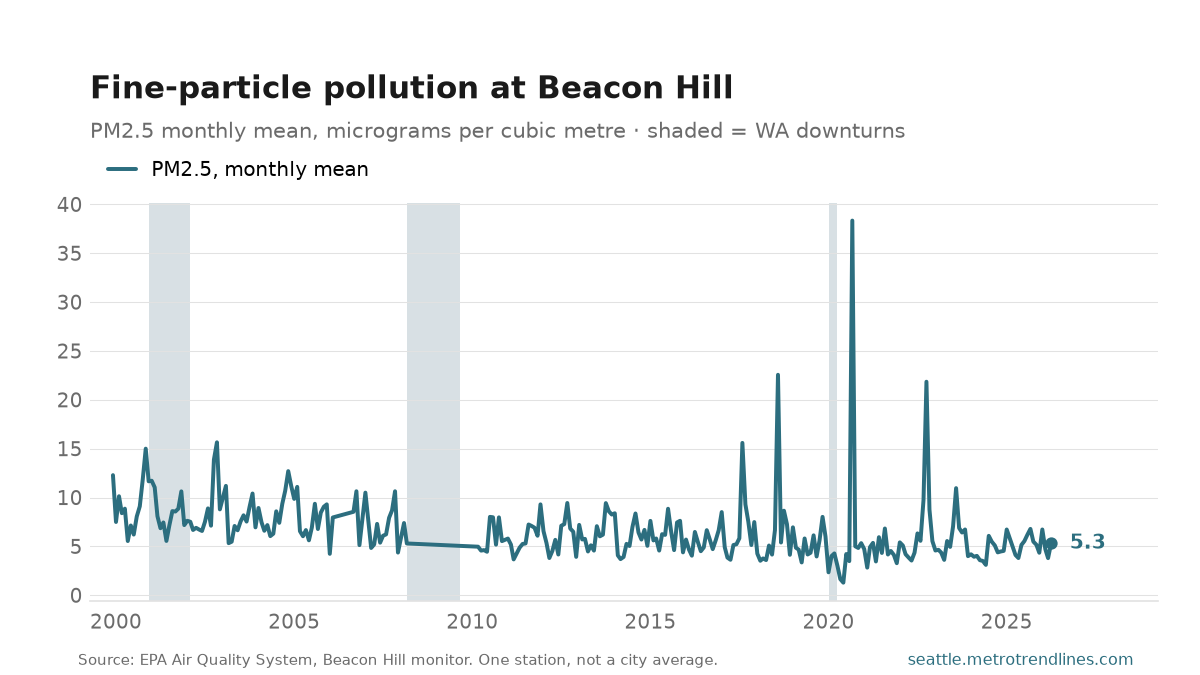
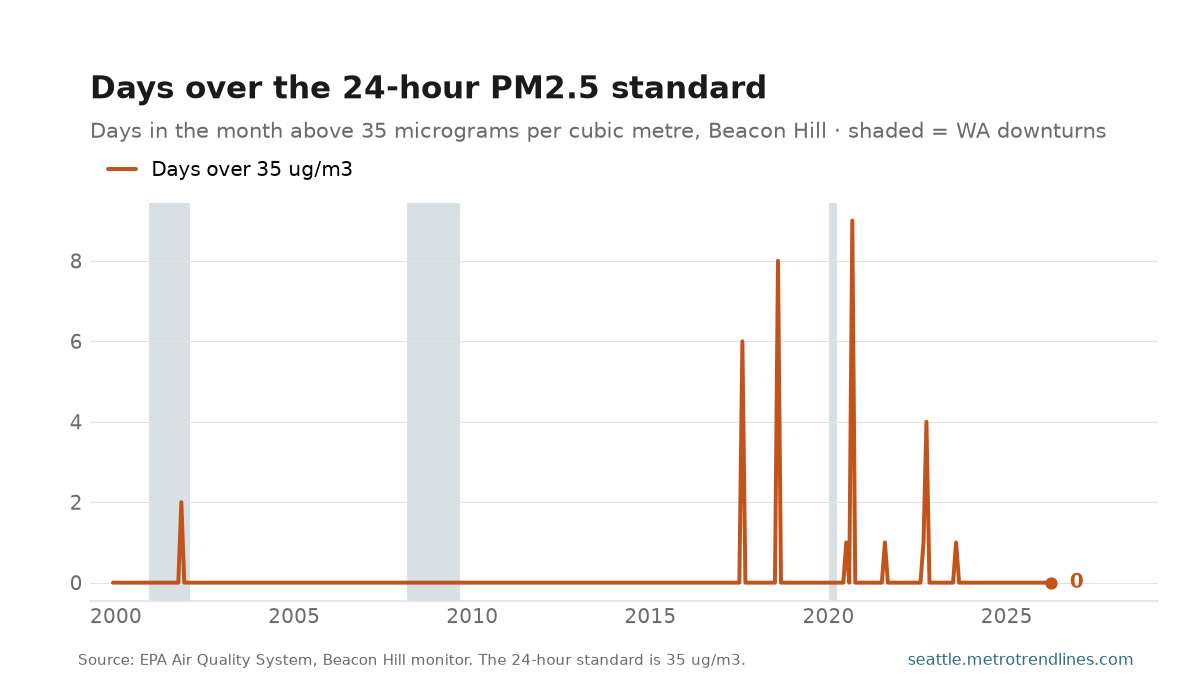
Fine particles at the Beacon Hill monitor averaged 5.3 micrograms per cubic metre in April 2026, up 28.6% from a year earlier. No day in the month went over the 24-hour standard of 35.
The monthly mean is the wrong statistic for smoke, which is why the day count sits beside it. Wildfire smoke arrives as a handful of genuinely dangerous days, and a month with four unbreathable days and twenty-six clean ones averages out to something unremarkable. The mean is the right measure of the ordinary background — traffic, wood stoves, industry — and that background has been falling for two decades. The days-over-35 count is the measure of the thing that actually sends people indoors.
Beacon Hill is one monitor and Seattle is not uniform: a site beside a freeway reads higher and a waterfront site lower on the same day. What one long-running station buys instead is comparability — the record reaches back to December 1999 at the same place, so the trend is real even where the level is local. The record month is 38 in September 2020.
Source: U.S. Environmental Protection Agency, Air Quality System, Beacon Hill monitor (site 53-033-0080), monthly mean PM2.5 and the count of days above the 35 ug/m3 24-hour standard. One monitor, not a citywide average. Auto-generated each build.